Home Energy Rating measures how energy efficient an existing home is. It builds on NatHERS, the scheme that has rated new homes for years. Every rating starts with a visit to the home, where someone records the details the rating is worked out from: its construction, insulation, windows, heating and cooling, hot water, floor plan, and much more.
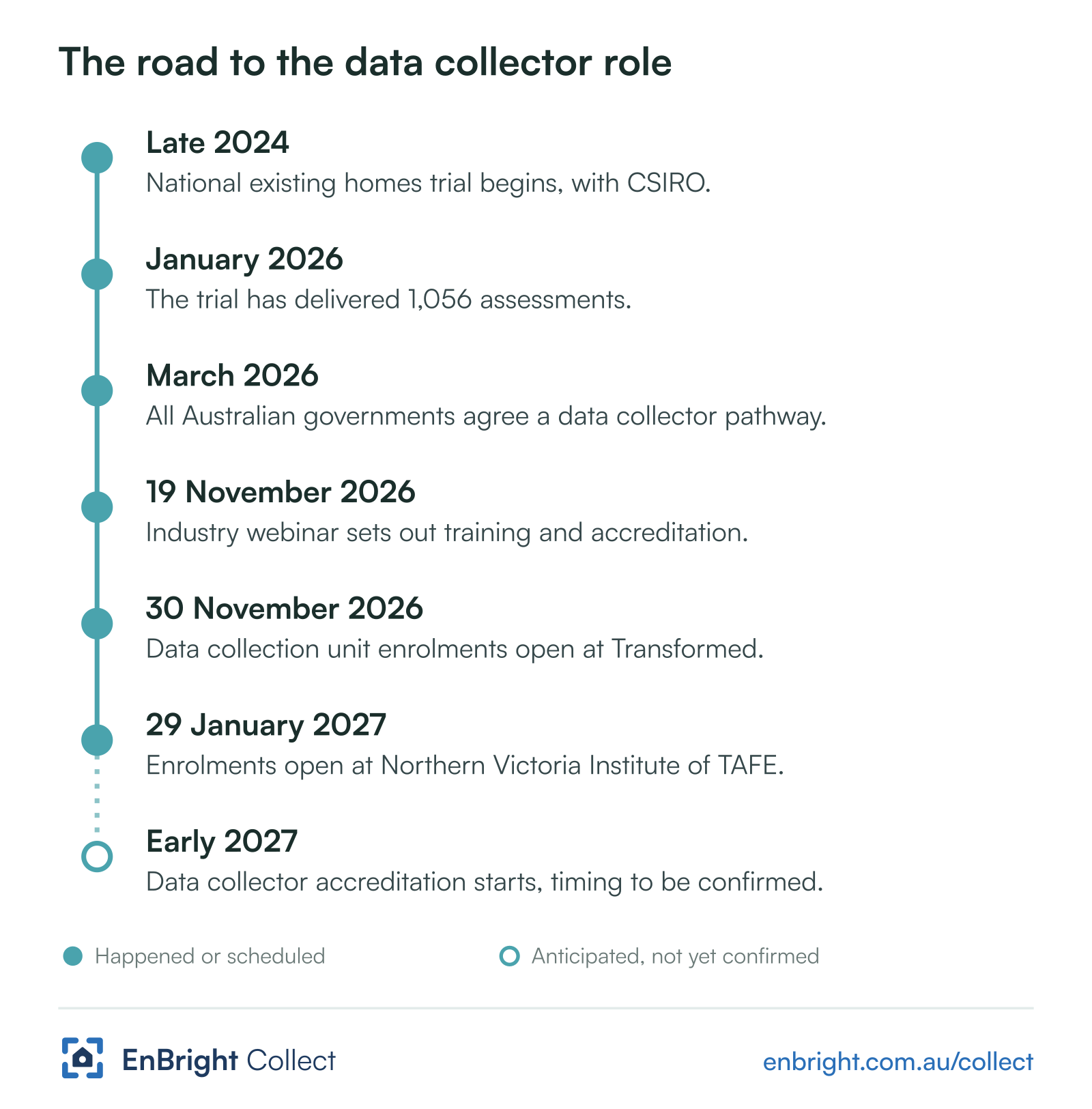
A new role will let trained people make that visit and collect those details, so an accredited assessor can then produce the rating from them without visiting the home. That role is the data collector. The pathway into it is opening in stages: two of the three training units are available now, enrolments for the third unit open from 30 November 2026, and accreditation is expected to start in early 2027.
Where the data collector role comes from
The national NatHERS for existing homes trial ran from late 2024 to early 2026, in collaboration with CSIRO, and delivered 1,056 assessments by January 2026. The trial tested two ways of working:
- The core stream. Trained assessors did the whole assessment themselves, from the home visit to the rating.
- The scale stream. Property valuers collected the data on site, and accredited assessors produced the rating off site. Four banks, two national valuation firms and three accredited assessor companies took part.
The trial outcomes report concluded that rating existing homes is a viable, fit-for-purpose scheme. The report was also candid about the scale stream: splitting the visit from the rating was feasible, but the split model was not yet ready for routine, high-volume assessments. At its November 2026 webinar, NatHERS said both ways of working delivered ratings with comparable accuracy.
A public consultation on a data collector pathway ran from November to December 2025, and NatHERS says most submissions supported it. In March 2026, all Australian governments agreed a dedicated training and accreditation pathway for data collectors.
What has been announced
- Agreed: by all Australian governments, March 2026 (official announcement).
- Training: three units, delivered by Transformed and Northern Victoria Institute of TAFE. Two units are available now, and enrolments for the third open from 30 November 2026.
- Accreditation: expected to start in early 2027, with the timing still to be confirmed. Design Matters National is the accreditation service provider for existing homes assessors and data collectors.
- Who it is for: new entrants, and existing professionals such as people working in construction, property, energy auditing and home sustainability services.
The training
NatHERS describes the training as streamlined. It has three units, and it is practical: the learning is task based, and competency is assessed in real homes.
| Unit | What it covers |
|---|---|
| CPPCOM4001 | Manage own work, professional development and ethical behaviour |
| CPPCOM4002 | Implement safe work practices in the property industry |
| Collect Data for Home Energy Ratings Assessments for Existing Homes | Collecting the data for an assessment, including mandatory tool training |
Two registered training organisations deliver the units:
| Provider | CPPCOM4001 and CPPCOM4002 | Data collection unit |
|---|---|---|
| Transformed | Available now | Enrolments open 30 November 2026 |
| Northern Victoria Institute of TAFE | Available now | Enrolments open 29 January 2027 |
For help with the cost, NatHERS listed the NSW Workforce Development Grants under training support and subsidies.
What accreditation involves
Training alone does not make you a data collector. You also need accreditation from Design Matters National, and NatHERS set out the requirements at the webinar:
- A competency exam: after completing the three training units, pass an independent pre-accreditation competency exam.
- Identity and background checks: a Nationally Coordinated Criminal History Check, plus disclosure of any relevant accreditation history and conflicts of interest.
- A signed agreement: a data collector agreement with Design Matters National.
- Insurance: professional indemnity cover of $2 million and public liability cover of $10 million.
- An ID card: accredited data collectors must carry their ID card and present it to households.
- Ongoing obligations: meet the privacy, work health and safety and Code of Practice requirements, complete 12 points of continuing professional development (CPD), and pass an annual competency exam.
What a data collector does
On a typical visit, a data collector walks through the home and records the details an assessor needs to then produce a Home Energy Rating: each room's dimensions and construction, the insulation, the windows and shading, and the heating, cooling and hot water systems, plus more.
In the example workflow NatHERS presented, the data collector identifies themselves to the household, completes an on-site work health and safety assessment, then collects measurements, observations, photographs and property details. Before leaving the job, the data collector checks that the data is accurate and the evidence is complete, then securely sends the record to the assessor.
A data collector cannot decide the rating outcome, produce or issue the certificate, or give the household upgrade guidance. An accredited assessor does all three, working from the data collector's records, and the assessor stays accountable for the final rating and certificate. Our guide to who does what covers the split in detail.
Who the role suits
NatHERS expects data collection to be added to services that already involve a home visit, such as valuations and building inspections. The role suits anyone who already spends their working day inside other people's homes:
- property valuers
- builders and building inspectors
- energy auditors and home sustainability assessors
- people new to the industry who want a practical, field-based way in
If you want to become a full assessor
A data collector gathers the data; an assessor turns that data into a rating. If you want to produce ratings yourself, the assessor pathway is open now:
- Existing homes: complete 7 units of competency drawn from the Certificate IV in Home Energy Efficiency and Sustainability (CPP41126), plus the NatHERS unit and software training, then apply for accreditation through Design Matters National. NatHERS lists two registered training organisations delivering this training: Northern Victoria Institute of TAFE and Transformed.
- New homes: complete the full Certificate IV (CPP41126).
The official become an assessor page has the current requirements.
The tools decide how the day goes
In the existing homes trial, a 3-bedroom house took 3 hours 30 minutes on average to assess, and over half of that time went on data entry after the visit. The capture tool decides how much of that data entry is left once you leave the house.
EnBright Collect is built for capture on site:
- Guided, room-by-room capture
- LiDAR floor plans†
- Property details pre-filled from 12 data sources
- Offline capture that syncs when you are back online
- Over 120 built-in rules that flag gaps and mistakes while you are still at the house
EnBright is currently developing EnBright Collect for data collectors, with the aim of launching it around the time the data collector pathway opens.*
What to do now
- Look at the training. CPPCOM4001 and CPPCOM4002 are available now at Transformed and Northern Victoria Institute of TAFE. Enrolments for the data collection unit open on 30 November 2026 at Transformed and on 29 January 2027 at Northern Victoria Institute of TAFE.
- Follow the official updates. The start date for accreditation has not been confirmed. It will be published at homeenergyrating.gov.au.
- Register your interest. Join the EnBright data collector list and we'll tell you when EnBright Collect is available for data collectors.
- Already an assessor? Apply for early access to EnBright Collect, with priority onboarding when access opens.
*Software accreditation is being sought. Our Expression of Interest is lodged with the NatHERS Administrator, subject to its assessment process.
†LiDAR scanning needs a device with a LiDAR sensor: iPhone 12 Pro or a later Pro model, or iPad Pro from 2020 onward.
Sources (read 18 and 19 November 2026): NatHERS data collector training and accreditation industry webinar (19 November 2026); NatHERS Trial Outcomes Report (April 2026); Data collector training news (March 2026); Existing homes delivery model; Funded assessor training and accreditation; Become an assessor.
Cover photo: House with number 109 in Corinda, Queensland by Kgbo, CC BY-SA 4.0, via Wikimedia Commons, cropped, darkened and annotated by EnBright. This annotated version is shared under the same licence.
