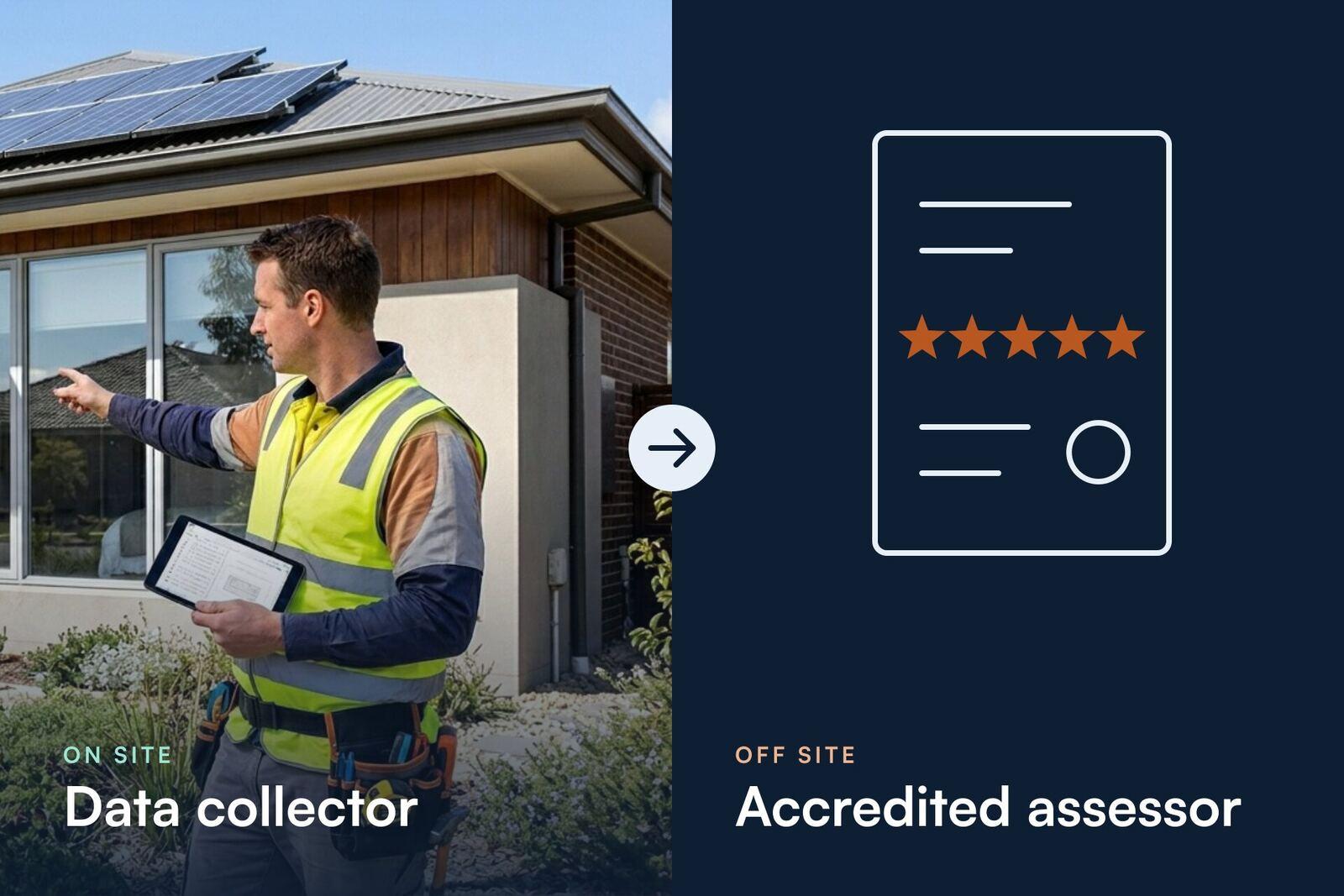
Home Energy Rating is adding a second role to the home visit. Until now, an accredited assessor has done every part of an assessment. Once data collector accreditation starts, expected in early 2027, an assessor can choose to have an accredited data collector gather the data on site instead.
Here is what NatHERS, the Nationwide House Energy Rating Scheme, says each role does.
The short version
| Data collector | Accredited assessor | |
|---|---|---|
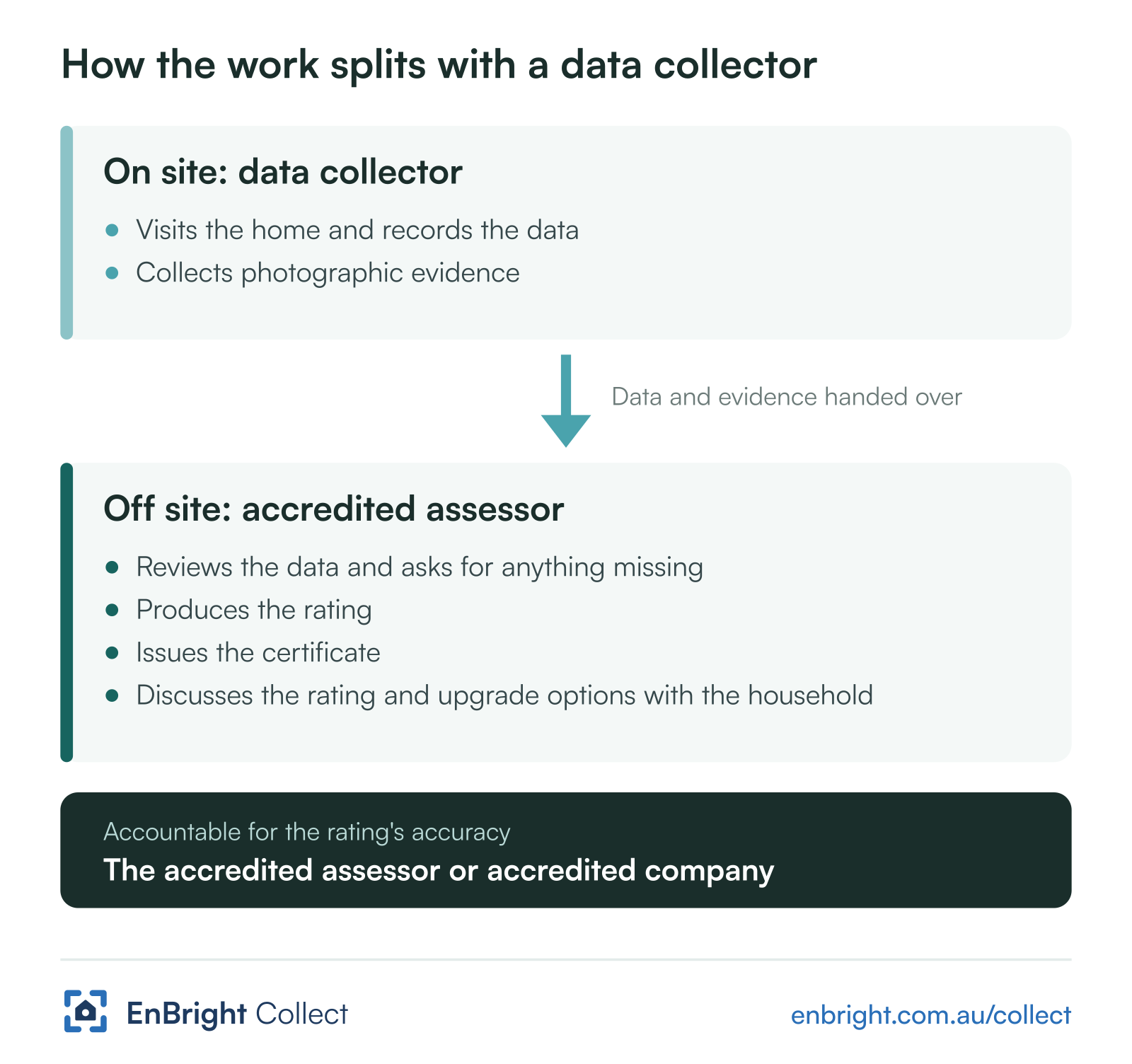
| Visits the home and records the data | Yes | Yes, or relies on a data collector |
| Collects photographic evidence | Yes | Yes |
| Produces the rating | No | Yes |
| Issues the certificate | No | Yes |
| Reviews the data and asks for anything missing | No | Yes |
| Discusses the rating and upgrade options with the household | No | Yes |
| Accountable for the rating's accuracy | No | Yes |
| Accredited by | Design Matters National | Design Matters National |
What the data collector does
The delivery model says assessors may choose to have an accredited data collector collect the data for an assessment on their behalf.
At the November 2026 webinar, NatHERS listed what each role is responsible for. Data collectors:
- inspect the home and collect the on-site data the assessment needs
- take measurements and record observations
- collect the required evidence
- provide the collected information and evidence to an assessor
A data collector cannot determine the final rating outcome, produce or issue a Home Energy Rating certificate, or provide or discuss upgrade guidance with households as part of the data collector role.
Assessors, working from what the data collector gathered on site:
- review the information and evidence
- decide whether there is enough information to complete the assessment
- request additional or clarified information
- produce and issue the Home Energy Rating
- make sure the rating complies with the NatHERS Technical Note for existing homes
- discuss the rating outcome and upgrade options with the household
A split assessment, step by step
NatHERS presented this as an example of a split assessment, and noted that workflows may differ between businesses.
| Step | Who | What happens |
|---|---|---|
| 1. Engage the client | Data collector or assessor | The household arranges the assessment with an assessor or a data collector, depending on the business model and the agreed working arrangements. |
| 2. Prepare for the visit | Data collector or assessor | The household is told what the visit involves and who will attend, and the required information and consents are collected. |
| 3. Collect data and evidence | Data collector | The data collector identifies themselves, completes an on-site work health and safety assessment, and collects measurements, observations, photographs and property details. |
| 4. Self check and hand over | Data collector | The data collector checks that the data is accurate and the evidence is complete, then securely sends the record to the assessor. |
| 5. Review the information | Assessor | The assessor confirms that the information and evidence are sufficient to complete the assessment in line with NatHERS requirements. |
| 6. Resolve any gaps | Assessor, with the data collector | The assessor identifies missing, unclear or inconsistent information, seeks further evidence and arranges further data collection if needed. |
| 7. Complete the assessment | Assessor | The assessor completes the assessment and issues the Home Energy Rating certificate. |
Who is accountable for the rating
The delivery model keeps a single point of accountability for the accuracy and integrity of the assessment and rating, assigned to the assessor or the accredited company. The consultation paper considered splitting accountability between the two roles and did not pursue it. NatHERS repeated the rule at the November 2026 webinar: the assessor completing the assessment remains accountable for the final rating and certificate.
In practice, that means the assessor puts their accreditation behind data they did not collect themselves. The quality of the data collector's capture becomes the assessor's risk, which is why the evidence collected on site matters so much.
How the two roles work together
Data collectors will work with accredited existing homes assessors to deliver ratings. The policies set the accreditation, compliance and assurance requirements, but they do not set requirements for how assessors and data collectors must work together. NatHERS says that leaves room for the market to scale and to fit data collection into services businesses already offer. It gave three scenarios:
- Regional coverage: an assessor works with locally available data collectors rather than travelling for every site visit. A sole trader assessor can service more areas and handle higher volumes by outsourcing data collection.
- Higher volumes: a business separates site collection from modelling, so it can manage several assessments at once across a larger service area. An assessment business can employ both assessors and data collectors.
- Complementary services: an accredited data collector adds data collection to an existing inspection service, such as a valuation or a building inspection, while an accredited assessor completes the rating. An existing business can also upskill its staff as accredited data collectors and hire or contract accredited assessors to deliver the ratings.
The updated policies also allow a dual assessor model, where the split is between two accredited assessors, alongside the data collector model and end-to-end assessments. The dual assessor model becomes available when the updated operational policies are published. The timeline NatHERS presented shows the split assessment model open to all accredited existing homes assessors from November 2026, before the first data collectors are accredited.
Accrediting whole companies, so a data collector could work under a company's accreditation, was raised in the consultation paper only as a future concept, with no timeline.
Training
| Data collector | Existing homes assessor | |
|---|---|---|
| Core training | Three units: CPPCOM4001, CPPCOM4002 and Collect Data for Home Energy Ratings Assessments for Existing Homes | 7 units drawn from the Certificate IV in Home Energy Efficiency and Sustainability (CPP41126), plus the NatHERS unit |
| Software | Mandatory tool training, included in the data collection unit | Software training |
| When | CPPCOM4001 and CPPCOM4002 are available now. Enrolments for the data collection unit open on 30 November 2026 (Transformed) and 29 January 2027 (Northern Victoria Institute of TAFE) | Open now |
The consultation paper had proposed that software training would be voluntary for data collectors. In the final training it is mandatory, as part of the data collection unit. Data collector training is practical, with competency assessed in real homes.
Accreditation
Design Matters National accredits both roles for existing homes. On top of the training, a data collector must pass an independent pre-accreditation competency exam and a Nationally Coordinated Criminal History Check, hold professional indemnity cover of $2 million and public liability cover of $10 million, and sign a data collector agreement with Design Matters National. Data collector accreditation is expected to start in early 2027, with the timing still to be confirmed. Our guide to becoming a data collector lists every requirement.
Quality and audits
Both roles sit inside the same quality system:
- Both must follow the NatHERS Code of Practice.
- Audits of existing homes assessments are carried out by independent experts engaged by the NatHERS Administrator. Under the proposal, the data collector's data is included in those audits (proposed).
- The accreditation provider can suspend or end the accreditation of either role.
- Assessors must also earn 12 CPD points and complete at least 3 assessments a year.
- Data collectors must complete 12 points of CPD and pass an annual competency exam.
- Data collectors must carry their ID card and present it to households.
What it means for your day
For an assessor, a data collector can free up hours of site visits, but only if the data arrives complete and evidenced. For a data collector, the job is done when the assessor can rate the home without a return visit.
EnBright Collect is built around that handover: guided room-by-room capture, photo checks, and over 120 rules that flag gaps before the data leaves the house.* The data collector works in the mobile app on site, which keeps capturing with or without phone signal. The assessor opens the same assessment in the web dashboard, where every measurement and photo sits in one place, ready to review before they produce the rating. See how it works.
New to the role? Read how to become a Home Energy Rating data collector.
*Software accreditation is being sought. Our Expression of Interest is lodged with the NatHERS Administrator, subject to its assessment process.
Sources (read 18 and 19 November 2026): NatHERS data collector training and accreditation industry webinar (19 November 2026); Existing homes delivery model and Delivery Model version 2; Consultation: additional training and accreditation pathways (November 2025); Data collector training news; Become an assessor.